Dark Energy Survey Year 3 results: Simulation-based \(w\)CDM inference from weak lensing and galaxy clustering maps with deep learning: Analysis design
Time: 14:00–15:00 (Munich time; Europe/Berlin)
Location: European Southern Observatory (ESO), Phoenix (C.2.02).
Paper summary
This paper develops and validates a simulation-based analysis of weak-lensing and galaxy-clustering maps for the Dark Energy Survey Year 3 configuration. Graph neural networks compress simulated sky maps into informative summaries, and normalizing flows use these summaries to infer cosmological parameters while accounting for observational and astrophysical uncertainties. Tests with synthetic observations show tighter forecast constraints than the paper’s two-point-statistics baseline, particularly when combining the two probes. The work establishes the analysis design ahead of applying it to the survey measurements.
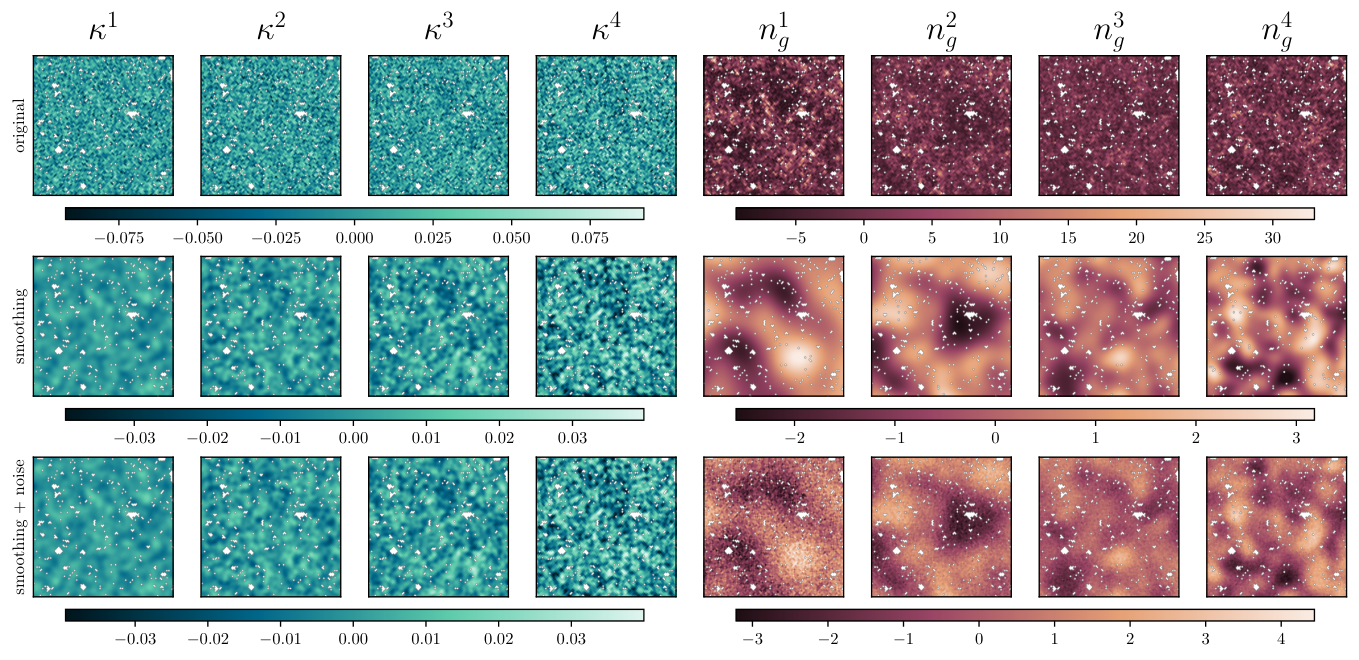
Figure 6 from Thomsen et al., showing how smoothing changes the simulated survey maps.
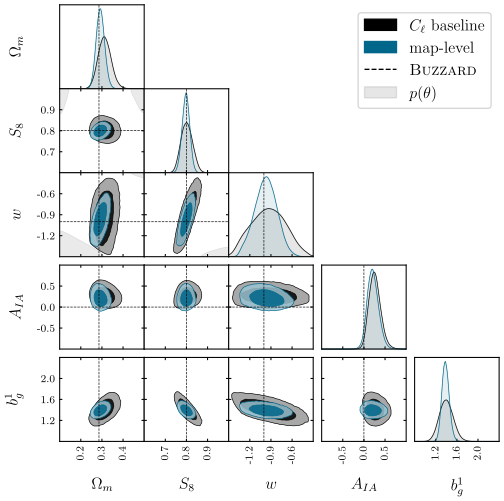
Figure 12 from Thomsen et al., comparing posterior forecasts from combined weak-lensing and galaxy-clustering mock observations using map-level analysis and the power-spectrum baseline.
Materials
Slides will be added here when available.